


In this blog
Northern lights: what matters most
- The viewing season is roughly late August to early April, when nights are dark enough.
- Clear sky, darkness, suitable geomagnetic activity and an open view all matter.
- Late evening to around local midnight is a useful viewing window, but displays can occur at other dark hours.
- Snow and extreme cold are not required.
- No accommodation, tour or app can guarantee a sighting.
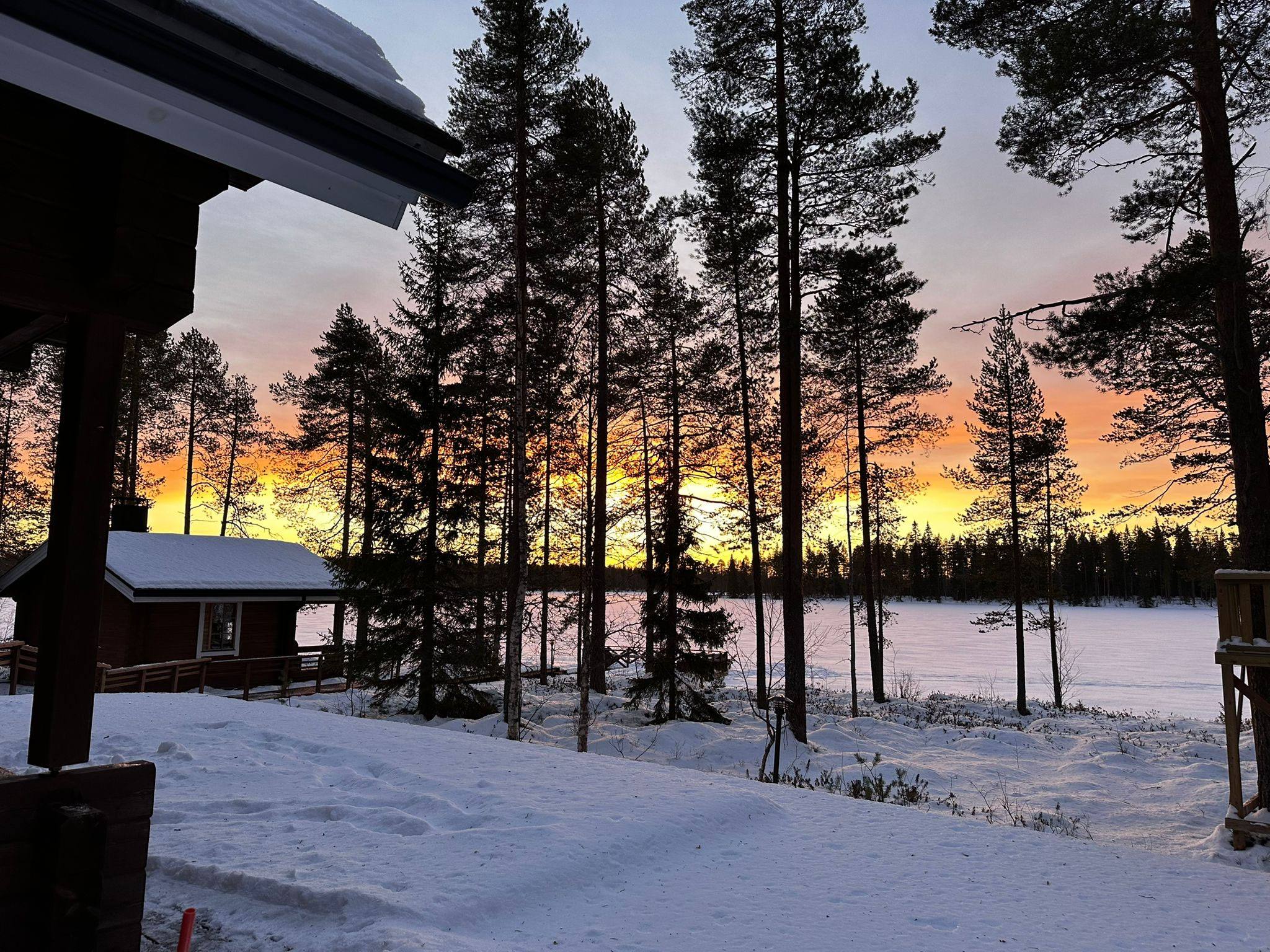
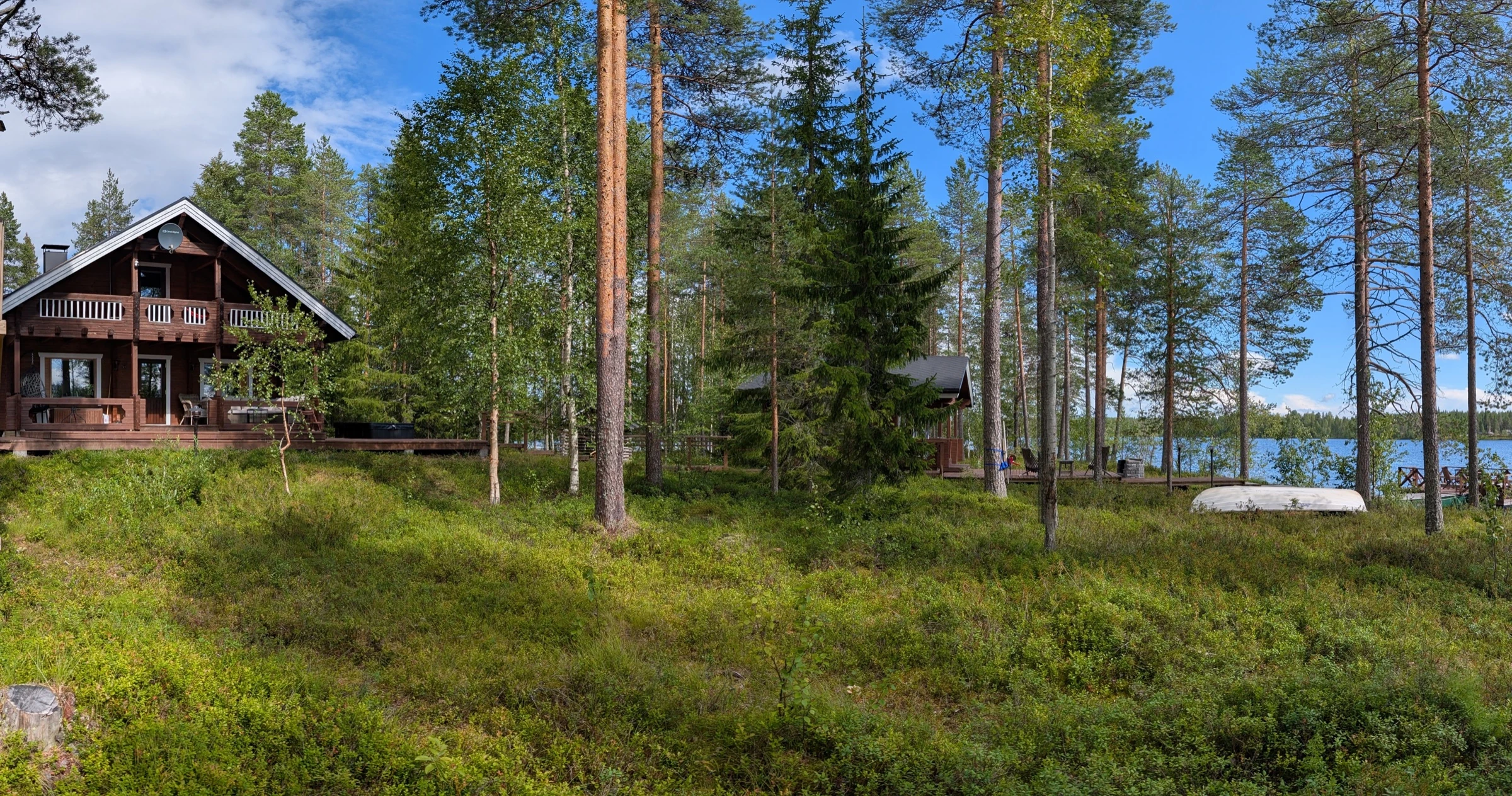
Mökki Tikka stands beside Koirajärvi, away from major artificial light. You can check the sky from the grounds or shore and return to the warm house between observations. An organised night excursion is an option, rather than something you must book every evening.
How do northern lights form?
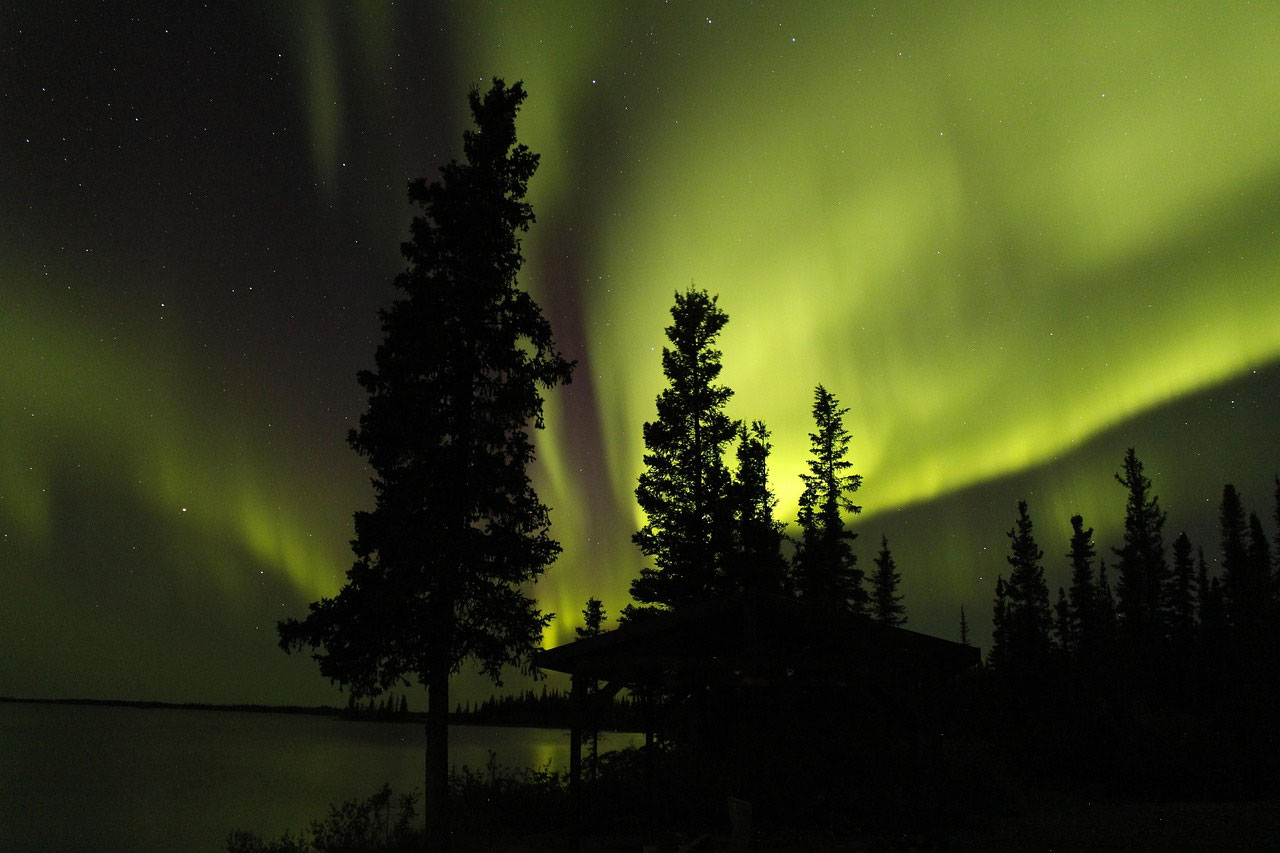
The Sun releases a flow of charged particles called the solar wind. Interactions with Earth's magnetic environment can accelerate particles into the upper atmosphere, where collisions involving oxygen and nitrogen produce light. Aurora forms far above ordinary weather clouds, from around 80 kilometres to several hundred kilometres above Earth.
Changes in these processes create arcs, rays, curtains and moving bands. A pale arc may remain almost still, while a stronger burst can change across a large area of sky within seconds.
Why green, red or violet?
Colour depends on the atmospheric species involved and the altitude of the emission. Oxygen produces the familiar green and also red light at greater heights. Nitrogen contributes blue and violet tones. Strong displays may include pink; weak ones can look whitish or grey to the human eye.
Photographs and real expectations
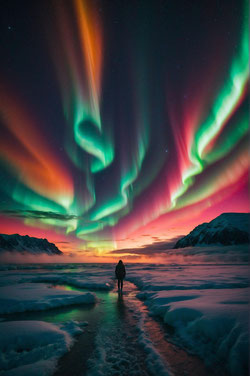
A camera collects light over time, so a photograph can show more colour than you see directly. Long exposure is not inherently dishonest, but it is different from the instant visual experience. Heavy editing or generated skies can create unrealistic expectations when presented as an unchanged scene.
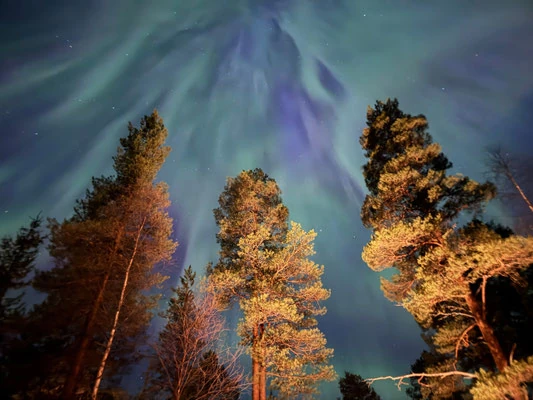
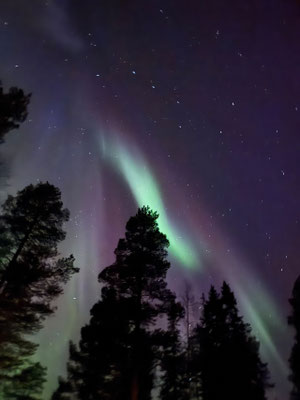
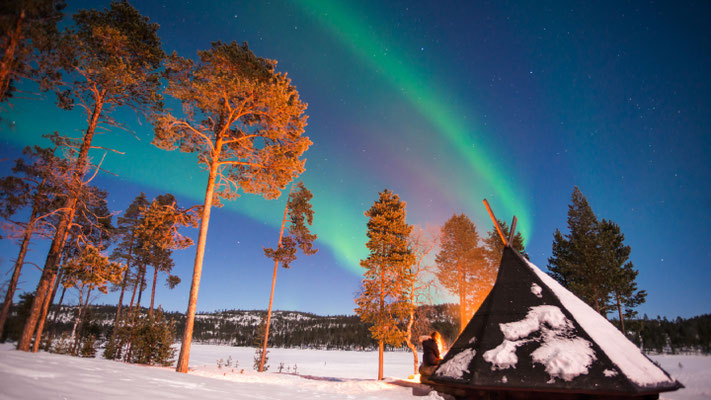
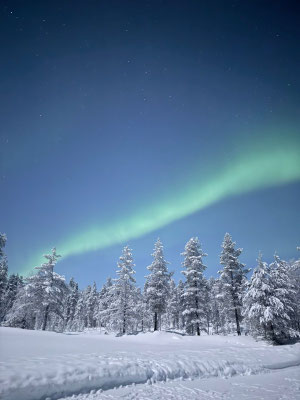
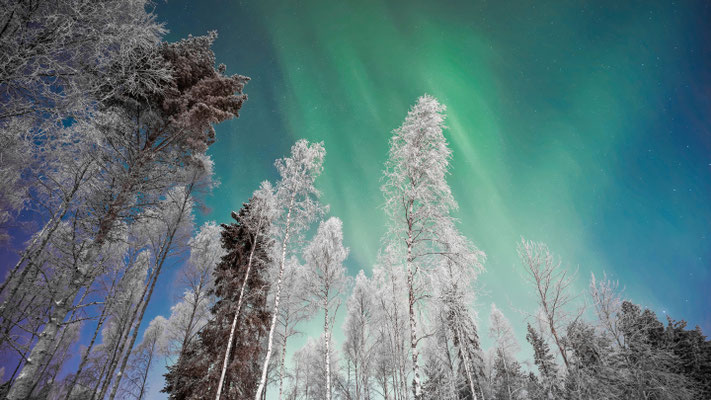
Weak aurora may first look like a pale veil. A test photograph can reveal green that is hard to see with your eyes. Strong displays can be clearly colourful and fast-moving without a camera. At Mökki Tikka, our own regional photographs are intended to show real experiences, without promising that each night will look the same.
The season, month by month
Late August and September
Darkness returns after the bright summer. Open lakes can reflect aurora, and viewing need not involve severe cold.
October and November
Nights become long, but clouds can interrupt viewing. The arrival of snow varies with location and year.
December and January
There are many dark hours. Warm clothing and regular indoor breaks matter, especially during cold spells. A long night still does not guarantee a clear sky.
February and March
These months combine winter scenery with increasing daytime light and enough darkness for aurora. They are appealing for a holiday that includes daytime outings as well as skywatching.
Early April and summer
Early April may still provide dark viewing hours, but they shrink rapidly. During the bright summer nights, aurora can occur above the atmosphere without being visible against the illuminated sky.
When should I go outside?
Roughly 9 pm to 1 am is a useful starting window, rather than a timetable. Displays can begin earlier or later, and several active periods may be separated by quiet hours. A stay of several nights gives you more opportunities to encounter different weather and activity.
General regional statistics describe many nights over time; they cannot be converted into a promise for your dates. Clouds often prevent a sighting even when aurora is active above them.
Choose a dark, open viewing place
Away from streetlights, look towards the northern horizon when activity is weak. Stronger displays can extend overhead or into other parts of the sky. An open shore offers more sky than a dense stand of trees.
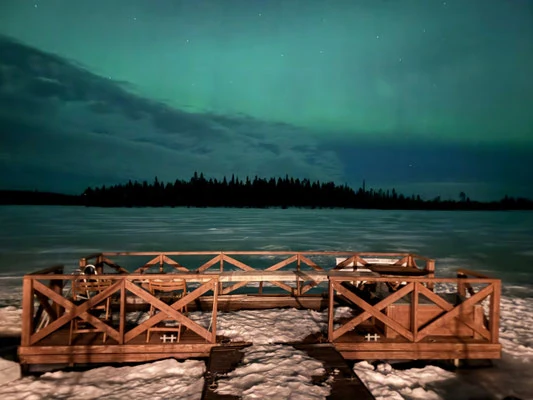
At Koirajärvi, use the grounds, shore or jetty when conditions are suitable. Never step onto a frozen lake merely because it looks solid or carries footprints. Reliable local assessment of the ice is essential.
Cold, moonlight and clouds
Cold does not cause aurora. Clear nights often become cold, which explains part of the association. Snow changes the foreground but is not necessary for the lights.
A full moon does not prevent a strong display. It can reduce the contrast of faint structures while lighting the snowy landscape for a photograph. Dense cloud blocks aurora because the light is produced far above it. Gaps or thin cloud can leave portions visible.
Recognising a faint display
Look for an arc or vertical rays rather than an ordinary moving cloud. Compare the shape over a few minutes and take a steady test photograph. A faint beginning may develop, but it may also remain faint or fade completely.
Photographing aurora with a phone
- Clean the lens and switch off the flash.
- Use night mode and the main camera rather than digital zoom.
- Support the phone on a tripod or stable surface.
- Use a short self-timer to avoid shaking it.
- Reduce exposure if bright aurora loses its structure.
Fast movement often needs a shorter exposure. Remember to look at the sky directly as well as through the screen.
Camera settings to start with
- Manual mode and RAW files if available.
- A wide aperture, for example f/1.4–f/2.8.
- ISO around 800–3200.
- An initial exposure of roughly 1–10 seconds.
- Manual focus checked on a distant star or light.
- A steady tripod; follow your camera's advice about stabilisation on a tripod.
These are starting points, not fixed rules. Shorten exposure for bright, fast curtains; extend it for weak, slower arcs when necessary. Keep spare batteries warm in an inside pocket and protect equipment from the weather.
Forecasts that are useful in Finland
Use the Finnish Meteorological Institute's aurora and space-weather information alongside its local cloud forecast. RWC Finland provides magnetic observations and sky-camera information. NOAA's short-term aurora product can help you understand the expected auroral oval. None of these replaces checking the sky at your location.
Finnish Meteorological Institute: aurora and space weather · RWC Finland · NOAA aurora forecast
What does Kp mean?
Kp is a global index of geomagnetic activity on a scale from 0 to 9. Higher values can indicate aurora extending farther south. In Lapland, however, lights may be visible at relatively low Kp. Local measurements, darkness and cloud cover are more useful than treating one app number as a verdict.
A practical evening routine
- Check the expected cloud cover during the afternoon.
- Look at local geomagnetic observations in the evening.
- Check outside briefly and regularly when it is dark.
- Continue to pay attention after a first weak display.
App alerts may refer to a large area or arrive at an imperfect time. A webcam elsewhere confirms conditions at that camera, not at your cottage. Cameras may also reveal colour more readily than your eyes.
Revontulet: fox fires
The Finnish word revontulet is often translated as fox fires. One traditional story tells of a magical fox whose tail sends sparks or bright snow into the sky. It is folklore rather than a scientific explanation, but it expresses the place of aurora in northern storytelling.
Other northern and Sámi traditions have different interpretations. These should not be flattened into one supposedly universal Sámi belief.
Watch safely
- Wear suitable layers, winter boots, a hat and warm hand protection.
- Carry a headlamp and a charged phone.
- Use reflectors near roads and stay out of the carriageway.
- Avoid unassessed lake ice and unsafe shore edges.
- Take warm breaks and stop if you become cold or tired.
- Tell someone your plan when leaving the grounds.
With children
Short visits outside are usually more practical than a long wait. Prepare boots and mittens, keep the face and ears protected, and let children stay warm indoors until there is something to see. A tired or chilled child does not need to remain outside for the photograph.
Frequently asked questions
Can I see aurora in September? Yes, once it is dark enough. In December or March? Both can offer opportunities, with different daylight and weather conditions. In summer? Bright nights normally prevent viewing.
Do I need snow or −30 °C? No. Does a full moon rule it out? No, although faint features can be less distinct. How many nights guarantee a sighting? No number guarantees one.
Must I book a tour? A tour can help with transport, location choice or photography, especially from a brightly lit town. From a dark accommodation with an open view, independent observation is also possible.
See the lakeside house, our packing guide and honest answers to Lapland travel questions.
The cabinExperiences & regionJournal